
 Carson Tahoe Health
Written by Gladys Dolor, APRN

Breast Health Awareness Month is a reminder to stay current with recommended screenings and pay attention to changes in your body. Gladys Dolor, APRN, answers common questions about mammograms, breast density, risk factors and what happens when a screening result needs a closer look.
When should women begin breast cancer screening?
“The American College of Radiology recommends annual screening mammograms starting at age 40 for women at average risk,” Gladys says. She also recommends a breast cancer risk assessment by age 25 to help identify people who may need to begin screening earlier.
Your personal history and risk factors can affect the screening plan that is right for you. People at higher risk, including those with certain inherited genetic mutations or a history of radiation to the chest, may need earlier screening or additional imaging. Talk with your healthcare provider about when to start and how often to be screened.
What breast changes should someone report?
“New or persistent changes in how the breasts look or feel should be reported to your provider,” Gladys says. These changes may include:
- A new lump or mass in the breast or underarm
- A change in breast size, shape or appearance
- Dimpling or puckering of the skin
- A nipple that newly turns inward, or changes to the skin around the nipple
- Nipple discharge, particularly if it is bloody or occurs on one side
- Pain in one area of the breast that persists
A lump is not the only change to watch for. If something looks or feels different to you, let your healthcare provider know.
What does it mean to have dense breasts?
Breast density describes the amount of glandular and fibrous tissue compared with fatty tissue seen on a mammogram. “There is no correlation between mammographic density and how the breast feels,” Gladys explains.
Dense breast tissue can make a mammogram harder to read because both dense tissue and tumors may appear white on the image. Breast density can also increase a person’s risk of developing breast cancer. Gladys recommends considering breast density alongside an individual risk assessment when discussing whether additional imaging may be helpful.
Can someone develop breast cancer without a family history?
“Yes, most breast cancers occur in women with no family history of the disease,” Gladys says. Family history is an important risk factor, but it is only one part of the picture.
“It is important to note that most women diagnosed with breast cancer have no identifiable risk factor beyond being female and older,” she adds. That is why routine screening matters even if breast cancer does not run in your family.
What else can increase breast cancer risk?
Gladys identifies several factors that may increase risk, including age, certain inherited genetic changes, dense breasts, a personal history of breast cancer, and prior radiation to the chest. Reproductive history, menopausal hormone therapy, alcohol use, smoking, physical inactivity and obesity after menopause may also play a role.
Having a risk factor does not mean you will develop breast cancer. A conversation with your healthcare provider can help you understand your individual risk and the screening options available to you.
Can men develop breast cancer?
“Yes, men can develop breast cancer although rare,” Gladys says. Warning signs can include a firm lump near the nipple, nipple discharge or bleeding, skin changes, or swelling in the underarm. Men who notice these changes should speak with a healthcare provider.
What happens after an abnormal mammogram?
An abnormal screening mammogram does not automatically mean cancer. Gladys says patients are typically asked to return for a diagnostic mammogram, an ultrasound or both so the care team can take a closer look. Depending on the results, the next step may be a biopsy or follow-up imaging at a later date.
If you receive a callback, complete the recommended follow-up and ask your care team what the results mean for you.
Make Time for Your Breast Health
A little time for your health can make a lasting difference. This Breast Health Awareness Month, make a plan to schedule your screening mammogram.
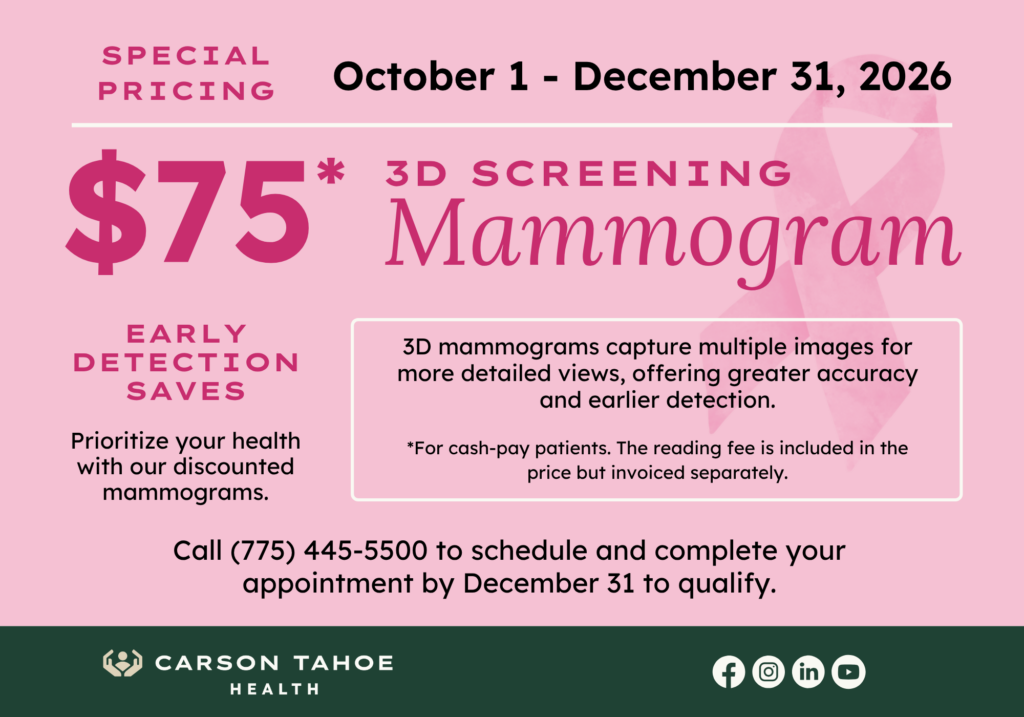
Carson Tahoe Health is offering 3D screening mammograms for $75 for cash-pay patients with appointments completed October 1 through December 31, 2026. The reading fee is included in the $75 total, though it will be billed separately.
To book the $75 mammogram offer, call (775) 445-5500 and complete your appointment by December 31 to qualify. For routine mammogram scheduling, you can also visit the Carson Tahoe Breast Center page to access MyChart.

 Carson Tahoe Health